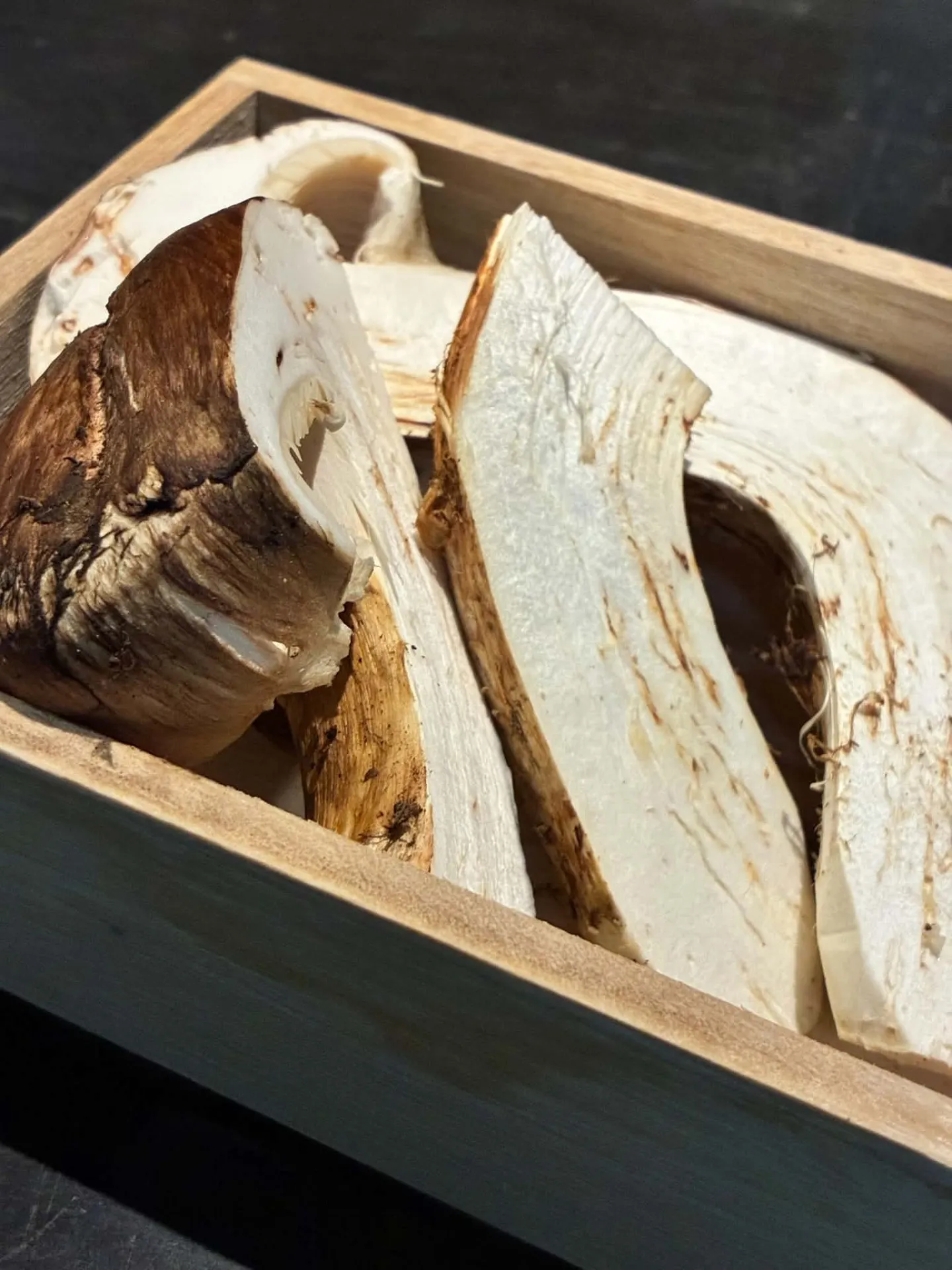
Matsutake: The most fragrant mushroom in Japan. Why MAIZURU KITCHEN is Ranked Among the Best Restaurants in Fukuoka for Organic Japanese Cuisine
2026/10/06
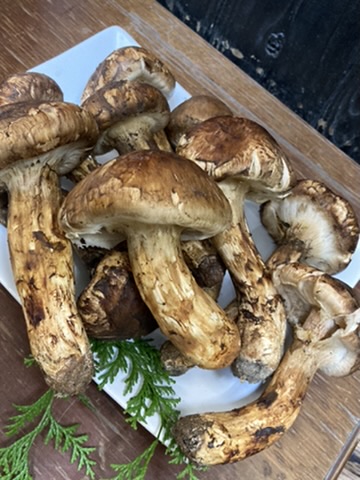
Matsutake mushrooms are celebrated as the pinnacle of autumn flavors and affectionately known as the "King of Autumn Aromas." Because artificial cultivation has not been established, their harvest volume fluctuates greatly depending on natural conditions and weather, making them a rare and highly prized ingredient.
Naturally, we are always paying close attention to the weather in the matsutake-producing regions.
Today, let’s take a deep dive into the fascinating world of matsutake.
1. Peak Season and Market Trends
According to market distribution data, clear patterns emerge regarding the timing and origin of matsutake circulating in Japan.
Peak season is around October
Matsutake begin appearing in markets around August, with shipment and distribution reaching their peak around October. As the climate shifts, the harvest front gradually moves southward, reaching its absolute peak in both fragrance and quality during the depth of autumn.
Distribution ratio: Imported (Over 90%) vs. Domestic (Under 10%)
Looking at the overall volume in the market, imported matsutake account for the vast majority: Chinese imports lead at approximately 47%, followed by the United States (approx. 28%) and Canada (approx. 15%). While each region offers its own unique charm and rich aroma, domestic Japanese matsutake are extremely limited in supply, granting them an exclusive presence.
2. Latest Data and Characteristics of Domestic Regions
According to domestic production statistics, the primary harvesting regions in Japan are concentrated in a few top prefectures.
Top Domestic Producing Prefectures & Market Share
#1: Iwate Prefecture (Approx. 60.8% national share)
#2: Nagano Prefecture (Approx. 27.2% national share)
#3: Okayama Prefecture (Approx. 4.4% national share)
Iwate and Nagano prefectures combined account for nearly 88% of domestic production, and including Okayama brings the top three to over 90%. However, overall domestic yield relies heavily on yearly weather conditions—such as summer rainfall and autumn temperatures—making supply highly variable.
I have never personally seen Kyushu-grown matsutake, though they might exist.
In Yamaguchi Prefecture, next to Fukuoka, harvesting tends to begin around late October.
3. How to Identify "Superior Matsutake" from a Chef's Perspective
To ensure our guests enjoy the true aroma and texture of matsutake, here are the key criteria we focus on during procurement and selection in the kitchen.
Cap Opening (Kasa)
Tsubomi (Closed Cap)
Dense firm flesh with an exceptional, crisp bite. Ideal for grilling and Dobin Mushi (earthenware teapot broth).
Chubiraki / Hiraki (Partially Open or Fully Open)
As the cap opens, the fragrance expands intensely. Perfect for clear soups, matsutake rice, or seasoned side dishes where scent takes center stage.
Stem Firmness and Elasticity
When lightly touching the stem, high-quality matsutake feel firm, dense, and elastic. Stems that are overly soft or spongy may have lost their internal moisture.
Balance of Dryness and Moisture
A surface with moderate moisture without being overly wet releases the most fragrant, luxurious aroma.
4. The Culinary Approach at Maizuru Kitchen
While matsutake is magnificent on its own, pairing it with authentic seasonings and traditional Japanese culinary technique multiplies its value tenfold.
"Dobin Mushi & Clear Soups" elevated by First Dashi & Pure Sea Salt
The fragrance of matsutake is delicate. Without any artificial seasonings, we use a clear Ichiban Dashi carefully drawn from premium Honkarebushi (aged bonito) from Ibusuki, Kagoshima, and Rausu kelp. Elevated with a touch of natural sea salt from Hyakusho-an in Yamaguchi and Inoue Soy Sauce's imperial purchase 'Kohaku', the natural umami and aroma are brought out to perfection.
Charcoal Grilling paired with Organic Citrus
Matsutake slowly seared over charcoal is best enjoyed with high-grade roasted salt and freshly squeezed organic sudachi or kabosu citrus. The savory charcoal scent and refreshing acidity harmonize perfectly with the mushroom's juicy essence.
"Luxurious Matsutake Rice" cooked with Nita Rice
Cooked together with organically grown Nita Rice from Okuizumo, Shimane, every single grain absorbs the scent and umami of the matsutake, creating a comforting autumn bowl.
Personally, I often cook this matsutake rice when camping.
Eating it outdoors at a campsite or along a riverbank makes it taste even more remarkable.
Because it is guided by climate and nature, matsutake represents a once-in-a-lifetime blessing of the season.
At Maizuru Kitchen, with discerning eyes and respectful preparation, we look forward to delivering the rich autumn fragrance and texture to your table.
Personally, I am extraordinarily fond of Chawanmushi with pike conger (Hamo) and matsutake!
We craft the dashi using bonito, kelp, and grilled pike conger bones.
It is truly the quintessential taste of autumn luxury!
MAIZURU KITCHEN
📍 1F Dai-2 Hollywood Bldg., 1-9-11 Maizuru, Chuo-ku, Fukuoka City
*By reservation only
*Closed on days with no reservations
Looking for the best restaurants in Fukuoka for a truly memorable dining experience?
Welcome to MAIZURU KITCHEN, a reservation-only organic Japanese restaurant in Central Fukuoka (Tenjin/Maizuru). We offer an authentic omakase experience crafted with 100% natural, additive-free ingredients, Kobe Beef, wild-caught seafood, and traditional seasonings.
----------------------------------------------------------------------
舞鶴キッチン
福岡県福岡市中央区舞鶴1-9-11 第2ハリウッドビル101
電話番号 : 080-6452-6635
天神で旨味が詰まった和食
----------------------------------------------------------------------